Is a Bear Part of the Pig Family
| Grunter | |
|---|---|
 | |
| A sus scrofa oinking | |
| Conservation status | |
| | |
Scientific nomenclature  | |
| Kingdom: | Animalia |
| Phylum: | Chordata |
| Class: | Mammalia |
| Order: | Artiodactyla |
| Family: | Suidae |
| Genus: | Sus |
| Species: | S. domesticus |
| Binomial name | |
| Sus domesticus Erxleben, 1777 | |
| Synonyms[2] | |
| |
The pig (Sus domesticus), often called swine, hog, or domestic squealer when distinguishing from other members of the genus Sus, is an omnivorous, domesticated, fifty-fifty-toed, hoofed mammal. It is variously considered a subspecies of the Eurasian boar or a distinct species, but the American Social club of Mammalogists considers it the latter.[3] The pig'due south head-plus-body length ranges from 0.nine to 1.8 m (3 to half-dozen ft), and developed pigs typically weigh between fifty and 350 kg (110 and 770 lb), with well-fed individuals even exceeding this range. The size and weight of hogs largely depends on their breed. Compared to other artiodactyls, a grunter's head is relatively long and pointed. Most even-toed ungulates are herbivorous, but pigs are omnivores, like their wild relative. Pigs grunt and make snorting sounds.
When used as livestock, pigs are farmed primarily for the production of meat, called pork. A group of pigs is chosen a passel, a team, or a sounder. The beast's bones, hibernate, and bristles are as well used in products. Pigs, especially miniature breeds, are kept as pets.
Biological science
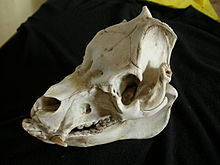


The pig typically has a big head, with a long snout which is strengthened by a special prenasal os and a disk of cartilage at the tip.[4] The snout is used to dig into the soil to observe food and is a very acute sense organ. The dental formula of adult pigs is iii.1.4.3 three.1.four.three , giving a full of 44 teeth. The rear teeth are adapted for crushing. In the male, the canine teeth can grade tusks, which grow continuously and are sharpened by constantly being ground against each other.[4]
Four hoofed toes are on each foot, with the ii larger central toes bearing almost of the weight, simply the outer 2 besides existence used in soft footing.[five]
Most pigs have rather a bristled sparse hair covering on their skin, although woolly-coated breeds such equally the Mangalitsa exist.[six]
Pigs possess both apocrine and eccrine sweat glands, although the latter appear express to the snout and dorsonasal areas.[vii] Pigs, however, similar other "hairless" mammals (e.one thousand. elephants, rhinos, and mole-rats), do not use thermal sweat glands in cooling.[viii] Pigs are too less able than many other mammals to dissipate oestrus from wet mucous membranes in the mouth through panting. Their thermoneutral zone is xvi to 22 °C (61 to 72 °F).[ix] At higher temperatures, pigs lose heat by wallowing in mud or water via evaporative cooling, although it has been suggested that wallowing may serve other functions, such as protection from sunburn, ecto-parasite command, and smell-marking.[x]
Pigs are 1 of iv known mammalian species which possess mutations in the nicotinic acetylcholine receptor that protect against snake venom. Mongooses, dearest badgers, hedgehogs, and pigs all have modifications to the receptor pocket which prevents the ophidian venom α-neurotoxin from binding. These correspond four dissever, independent mutations.[11]
Pigs have pocket-size lungs in relation to their trunk size, and are thus more susceptible than other domesticated animals to fatal bronchitis and pneumonia.[12]
Genetics and genomics
The genome of the sus scrofa has been sequenced and contains nigh 22,342 protein-coding genes.[13] [14] [15]
Taxonomy
The pig is most often considered to be a subspecies of the wild boar, which was given the name Hog past Carl Linnaeus in 1758; following from this, the formal name of the sus scrofa is Sus scrofa domesticus.[sixteen] [17] However, in 1777, Johann Christian Polycarp Erxleben classified the grunter equally a dissever species from the wild boar. He gave it the proper name Sus domesticus, which is still used by some taxonomists.[18] [xix]
History


Archaeological bear witness suggests that pigs were domesticated from wild boar in the Well-nigh E in the Tigris Bowl,[20] [ page needed ] Çayönü, Cafer Höyük, Nevalı Çori[21] being managed in the wild in a way similar to the way they are managed past some modern New Guineans.[22] Remains of pigs have been dated to earlier than 11,400 years ago in Cyprus. Those animals must have been introduced from the mainland, which suggests domestication in the adjacent mainland by then.[23] There was besides a separate domestication in China which took identify about 8,000 years agone.[24] [25]
In the Near Eastward, sus scrofa husbandry spread for the next few millennia. It reduced gradually during the Bronze Age, as rural populations focused instead on commodity-producing livestock. It was sustained in urbanized regions, still.[26]
Dna bear witness from subfossil remains of teeth and jawbones of Neolithic pigs shows that the first domestic pigs in Europe had been brought from the Well-nigh Due east. This stimulated the domestication of local European wild boar, resulting in a 3rd domestication event with the Almost Eastern genes dying out in European pig stock. Modern domesticated pigs take involved complex exchanges, with European domesticated lines existence exported, in turn, to the ancient Near E.[27] [28] Historical records indicate that Asian pigs were introduced into Europe during the 18th and early 19th centuries.[24]
In August 2015, a study looked at over 100 grunter genome sequences to ascertain their process of domestication, which was assumed to have been initiated by humans, involved few individuals, and relied on reproductive isolation between wild and domestic forms. The report institute that the assumption of reproductive isolation with population bottlenecks was not supported. The report indicated that pigs were domesticated separately in Western Asia and People's republic of china, with Western Asian pigs introduced into Europe, where they crossed with wild boar. A model that fit the data included a mixture with a now extinct ghost population of wild pigs during the Pleistocene. The written report also found that despite dorsum-crossing with wild pigs, the genomes of domestic pigs have strong signatures of selection at DNA loci that affect beliefs and morphology. The report ended that human option for domestic traits likely counteracted the homogenizing effect of cistron period from wild boars and created domestication islands in the genome. The aforementioned process may also apply to other domesticated animals.[29] [thirty] In 2019, a report showed that the squealer had arrived in Europe from the Near East 8,500 years ago. Over the next three,000 years they then admixed with the European wild boar until their genome showed less than v% Well-nigh Eastern ancestry, yet retained their domesticated features.[31]
Among the animals that the Spanish introduced to the Chiloé Archipelago in the 16th century, pigs were the most successful to adapt. The pigs benefited from arable shellfish and algae exposed by the large tides of the archipelago.[32] Pigs were brought to southeastern North America from Europe past de Soto and other early Spanish explorers. Escaped pigs became feral and acquired a great bargain of disruption to Native Americans.[33] Feral pig populations in the southeastern United States have since migrated north and are a growing concern in the Midwest. Considered an invasive species, many state agencies have programs to trap or hunt feral pigs equally means of removal.[34] [35] [36] Domestic pigs have get feral in many other parts of the earth (due east.1000. New Zealand and northern Queensland) and have acquired substantial ecology damage.[37] [38] Feral hybrids of the European wild boar with the domestic squealer are likewise very disruptive to both environment and agriculture (among the 100 most damaging animal species),[39] especially in southeastern South America from Uruguay to Brazil's Mato Grosso do Sul and São Paulo.[40] [41] [42] [43] [44]
With around one billion individuals alive at any time, the domesticated squealer is one of the well-nigh numerous large mammals on the planet.[45] [46]
Reproduction
Female pigs reach sexual maturity at 3–12 months of age and come up into estrus every 18–24 days if they are not successfully bred. The variation in ovulation charge per unit can be attributed to intrinsic factors such as age and genotype, too as extrinsic factors like nutrition, surroundings, and the supplementation of exogenous hormones.[47] The gestation period averages 112–120 days.[48]
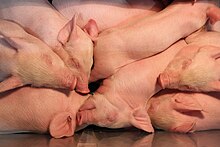
Piglets keeping warm together
Oestrus lasts ii to three days, and the female's displayed receptiveness to mate is known as standing rut. Continuing heat is a reflexive response that is stimulated when the female is in contact with the saliva of a sexually mature boar. Androstenol is ane of the pheromones produced in the submaxillary salivary glands of boars that will trigger the female'south response.[49] The female person cervix contains a series of five interdigitating pads, or folds, that will agree the boar's corkscrew-shaped penis during copulation.[50] Females have bicornuate uteruses and two conceptuses must be present in both uterine horns for pregnancy to be established.[51] Maternal recognition of pregnancy in pigs occurs on days 11 to 12 of pregnancy and is marked by progesterone product from a functioning corpus luteum (CL).[52] To avoid luteolysis by PGF2α, rescuing of the CL must occur via embryonic signaling of estradiol 17β and PGE2.[53] This signaling acts on both the endometrium and luteal tissue to preclude the regression of the CL by activation of genes that are responsible for CL maintenance.[54] During mid to late pregnancy, the CL relies primarily on luteinizing hormone (LH) for maintenance until parturition.[53] Animal nutrition is important prior to reproduction and during gestation to ensure optimum reproductive performance is accomplished.[55]
Archeological evidence indicates that medieval European pigs farrowed, or bore a litter of piglets, once per year.[56] By the nineteenth century, European piglets routinely double-farrowed, or bore two litters of piglets per year. It is unclear when this shift occurred.[57]
Beliefs
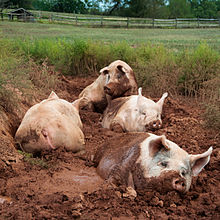
In many ways, their behaviour appears to be intermediate between that of other artiodactyls and of carnivores.[58] Pigs seek out the company of other pigs and often huddle to maintain concrete contact, although they do not naturally form big herds. They typically alive in groups of about 8–x adult sows, some immature individuals, and some unmarried males.[59]
Because of their relative lack of sweat glands, pigs often control their body temperature using behavioural thermoregulation. Wallowing, which ofttimes consists of coating the body with mud, is a behaviour often exhibited past pigs.[60] They do not submerge completely under the mud, only vary the depth and elapsing of wallowing depending on environmental conditions.[60] Typically, adult pigs commencement wallowing once the ambience temperature is around 17–21 °C (63–seventy °F). They cover themselves from head to toe in mud.[60] Pigs may use mud as a sunscreen, or as a method of keeping parasites abroad.[60] Most bristled pigs will "accident their coat", meaning that they shed most of the longer, coarser strong hair in one case a year, usually in spring or early summer, to prepare for the warmer months ahead.[61]
If conditions permit, pigs feed continuously for many hours and and so sleep for many hours, in dissimilarity to ruminants which tend to feed for a brusque time then sleep for a short time. Pigs are omnivorous, and are highly versatile in their feeding behaviour. As they are foraging animals, they primarily eat leaves, stems, roots, fruits, and flowers.[62] Pigs play an important part in regions where hog toilets are employed. Pigs are highly intelligent animals,[63] on par with dogs,[64] and according to David DiSalvo'south writing in Forbes, they are "widely considered the smartest domesticated animate being in the globe. Pigs can movement a cursor on a video screen with their snouts and sympathise what is happening onscreen, and even acquire to distinguish betwixt the scribbles they knew from those they saw for the kickoff time."[65] [a] [69]
Rooting

Juliana piglet rooting on her sibling's belly
Rooting is an instinctual behavior in pigs that is characterized past a grunter nudging its snout into something. Similar to a true cat'due south kneading, rooting is found comforting. It get-go happens when piglets are built-in to obtain their mother'southward milk, and tin can become a habitual, obsessive beliefs which is near prominent in animals weaned too early on.[seventy] Often, pigs will root and dig into the ground to forage for food.[lxx] By means of rooting, pigs take been used to till farmland.
Rooting is known to also be used every bit a means of advice.[70] Nose rings that pierce the septum of the olfactory organ discourage rooting because they make the behavior painful.
The breed known as the kunekune hardly ever roots, every bit it can sustain itself by feeding on nothing other than grass.[71] Not having to root around in the soil to observe underground food (e.g. tubers), it thus has evolved to, for the most part, not possess the instinct for rooting.
Nest-building
A behavioural characteristic of pigs which they share with carnivores is nest-building. Sows root in the footing to create depressions and and then build nests in which to give nativity. First, the sow digs a low nearly the size of her body. She then collects twigs and leaves, and carries these in her mouth to the low, building them into a mound. She distributes the softer, finer material to the middle of the mound using her feet. When the mound reaches the desired meridian, she places large branches, up to 2 metres in length, on the surface. She enters into the mound and roots around to create a depression within the gathered textile. She then gives nascency in a lying position, which, once again, is different from other artiodactyls, which usually give birth in a standing position.[58]
Nest-building behaviour is an of import function in the process of pre and mail-partum maternal behaviour. Nest-edifice volition occur during the last 24 hours before the onset of farrowing and becomes nigh intense during 12 to 6 hours earlier farrowing.[72] Nest-building is divided into two phases: one of which is the initial phase of rooting in the basis while the 2d stage is the collecting, carrying and arranging of the nest fabric.[72] The sow volition separate from the group and seek a suitable nest site with some shelter from pelting and wind that has well-drained soil. This nest-building behaviour is performed to provide the offspring with shelter, comfort, and thermoregulation. The nest will provide protection against conditions and predators while keeping the piglets close to the sow and abroad from the rest of the herd. This ensures they do not go trampled on and that other piglets are not stealing milk from the sow.[73] Nest-building can exist influenced by internal and external stimuli. Internal hormonal changes and the completion of one nesting phase are indicators of this maternal behaviour.[73] The onset is triggered by the rise in prolactin levels, which is caused past a decrease in progesterone and an increment in prostaglandin, while the gathering of the nest cloth seems to be regulated more by external stimuli such as temperature.[72] The longer time spent on nest-building will increase pre-partum oxytocin.
Nursing and suckling behaviour

Sow with prominent nipples. Pigs typically have 12–14 nipples.
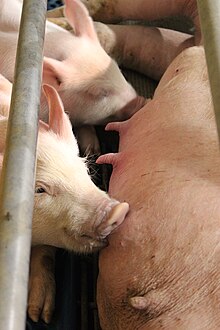
Pigs display complex nursing and suckling behaviour.[74] Nursing occurs every 50–60 minutes, and the sow requires stimulation from piglets before milk allow-down. Sensory inputs (vox, odours from mammary and nascency fluids and hair patterns of the sow) are peculiarly important immediately post-birth to facilitate teat location by the piglets.[75] Initially, the piglets compete for position at the udder; then the piglets massage around their respective teats with their snouts, during which time the sow grunts at slow, regular intervals. Each series of grunts varies in frequency, tone and magnitude, indicating the stages of nursing to the piglets.[76]
The phase of competition for teats and of nosing the udder lasts for most one minute and ends when milk flow begins. In the third phase, the piglets hold the teats in their mouths and suck with slow mouth movements (ane per second), and the rate of the sow'southward grunting increases for approximately twenty seconds. The grunt peak in the third phase of suckling does not coincide with milk ejection, just rather the release of oxytocin from the pituitary into the bloodstream.[77] Phase 4 coincides with the menses of principal milk period (ten–20 seconds) when the piglets suddenly withdraw slightly from the udder and showtime sucking with rapid oral fissure movements of about iii per second. The sow grunts rapidly, lower in tone and oft in quick runs of three or four, during this stage. Finally, the flow stops and then does the grunting of the sow. The piglets may then sprint from teat to teat and recommence suckling with wearisome movements, or nosing the udder. Piglets massage and suckle the sow's teats after milk menses ceases every bit a manner of letting the sow know their nutritional status. This helps her to regulate the amount of milk released from that teat in time to come sucklings. The more intense the mail service-feed massaging of a teat, the greater the future milk release from that teat will be.[78]
Teat order

A sow with suckling piglets
In pigs, dominance hierarchies tin exist formed at a very early age. Piglets are highly precocious and within minutes of being born, or sometimes seconds, will attempt to suckle. The piglets are built-in with precipitous teeth and fight to develop a teat order as the anterior teats produce a greater quantity of milk. Once established, this teat society remains stable with each piglet disposed to feed on a particular teat or grouping of teats.[58] Stimulation of the anterior teats appears to be important in causing milk letdown,[79] so information technology might be advantageous to the unabridged litter to have these teats occupied past healthy piglets. Using an bogus sow to rear groups of piglets, recognition of a teat in a particular area of the udder depended initially on visual orientation by ways of reference points on the udder to find the area, and then the olfactory sense for the more accurate search within that area.[80]
Senses
Pigs have panoramic vision of approximately 310° and binocular vision of 35° to l°. Information technology is thought they accept no eye accommodation.[81] Other animals that have no accommodation, east.grand. sheep, lift their heads to see distant objects.[82] The extent to which pigs take color vision is notwithstanding a source of some debate; yet, the presence of cone cells in the retina with two distinct wavelength sensitivities (blue and green) suggests that at to the lowest degree some colour vision is present.[83]
Pigs have a well-developed sense of odor, and utilize is made of this in Europe where they are trained to locate secret truffles. Olfactory rather than visual stimuli are used in the identification of other pigs.[84] Hearing is also well adult, and localisation of sounds is made by moving the head. Pigs utilize auditory stimuli extensively as a means of advice in all social activities.[85] Alarm or aversive stimuli are transmitted to other pigs non only past auditory cues simply also by pheromones.[86] Similarly, recognition between the sow and her piglets is by olfactory and vocal cues.[87]
Breeds
Many breeds of pig be, with different colors, shapes, and sizes. According to The Livestock Conservancy, equally of 2016, three breeds of sus scrofa are critically rare (having a global population of fewer than 2000). They are the Choctaw grunter, the Mulefoot, and the Ossabaw Island sus scrofa.[88] The smallest known pig brood in the world is the Göttingen minipig, typically weighing near 26 kilograms (57 lb) as a healthy, total-grown adult.[89]
In agriculture
| Global Pig stock | |
|---|---|
| in 2019 | |
| Number in millions | |
 China (Mainland) China (Mainland) | 310.iv |
 Eu (UK non included) Eu (UK non included) | 143.one |
 The states The states | 78.vii |
 Brazil Brazil | 40.6 |
 Russia Russia | 23.vii |
 Myanmar Myanmar | 21.6 |
 Vietnam Vietnam | xix.six |
 Mexico Mexico | 18.iv |
 Canada Canada | 14.1 |
 Philippines Philippines | 12.seven |
| | |
| World total | 850.3 |
| Source: UN Food and Agriculture Organization | |


Exterior of grunter subcontract in Vampula, Finland, 2021

A Large White, a breed normally used in meat product
When in utilise as livestock, the pig is generally farmed for its meat, pork. Other food products made from pigs include pork sausage (which includes casings that are made from the intestines), bacon, gammon, ham and pork rinds. The head of a grunter can exist used to make a preserved jelly called head cheese, which is sometimes known as brawn. Liver, chitterlings, blood (for blackness pudding), and other offal from pigs are also widely used for food. In some religions, such every bit Judaism and Islam, pork is a taboo food. Approximately 1.5 billion pigs are slaughtered each year for meat.[xc]
The use of pig milk for homo consumption does take place, but equally in that location are sure difficulties in obtaining it, there is lilliputian commercial production.
Livestock pigs are exhibited at agricultural shows, judged either as stud stock compared to the standard features of each pig breed, or in commercial classes where the animals are judged primarily on their suitability for slaughter to provide premium meat.
The skin of pigs is eaten and used to produce seat covers, wearing apparel, and other items.
In some developing and adult nations, the pig is usually raised outdoors in yards or fields. In some areas, pigs are allowed to provender in woods where they may be taken care of by swineherds. In industrialized nations such as the United states of america, sus scrofa farming has switched from the traditional pig farm to big-scale intensive hog farms. This has resulted in lower production costs but tin cause significant cruelty problems. Every bit consumers take become concerned with the humane treatment of livestock, demand for pasture-raised pork in these nations has increased.[91]
As pets

Vietnamese Pot-bellied pigs, a miniature breed of grunter, have made popular pets in the United States, beginning in the latter half of the 20th century.
In many respects, pot-bellied pigs are desirable and entertaining pets. They are considered intelligent, gregarious, and trainable. They lack the genetic hereditary weaknesses which usually agonize certain pedigree true cat and domestic dog breeds, are generally quite sturdy, and have a reasonably affordable diet despite requiring large quantities of food. All the same, they tin exist potent-willed, defiant, and contained pets which will sometimes defy training. They require access to an outdoor space at all times, and depending on the private pig, may become housebroken easily or never settle indoors. While hardy, an injured or sick sus scrofa will require plush surgery or larger than boilerplate quantities of medicine than most pets.[92]
Pigs are highly intelligent, social creatures. They are considered hypoallergenic, and are known to practice quite well with people who have the usual animate being allergies. Since these animals are known to take a life expectancy of 15 to 20 years, they require a long-term commitment.
Given pigs are bred primarily every bit livestock and accept not been bred as companion animals for very long, selective breeding for a placid or biddable temperament is not well established. Pigs accept radically different psychology to dogs and exhibit fight-or-flying instincts, independent nature, and natural assertiveness which tin can manifest as aggression towards children and a tendency to panic and lash out with footling warning. Cats generally are rubber around pigs as neither species has an incentive to express assailment or fear towards the other, although dogs will view pigs as prey animals and in plow, pigs volition challenge dogs for nutrient, leading to very violent fights.[93]

A "Salt & Pepper" miniature squealer
Intendance
Male and female swine that take not been de-sexed may express unwanted ambitious beliefs, and are prone to developing serious health issues.[94] Regular trimming of the hooves is necessary; hooves left untreated cause major pain in the pig, can create malformations in bone structure and may cause him or her to be more than susceptible to fungal growth between crevices of the hoof,[95] or between the cracks in a split hoof. Male pigs, specially when left unaltered, can grow big, sharp tusks which may go along growing for years. Domestic owners may wish to keep their pigs' tusks trimmed back,[96] or take them removed entirely.
As casualty animals, pigs' natural instinctive behavior causes them to take a stiff fear of being picked up, resulting in the brute expressing stress through struggling and squealing, but they volition usually at-home downwardly once placed back onto the ground. This instinctual fright may be lessened if the pig has been oftentimes held since infancy. When property pigs, supporting them under the legs makes beingness held not as stressful for the animal.[97] Pigs need enrichment activities[98] to keep their intelligent minds occupied; if pigs go bored, they oftentimes become destructive.[99] Equally rooting is constitute to exist comforting, pigs kept in the firm may root household objects, article of furniture or surfaces. While some owners are known to pierce their pigs' noses to discourage rooting behaviour, the efficacy and humaneness of this practice is questionable.[100] Pet pigs should exist allow outside daily to let them to fulfill their natural desire of rooting effectually.
In human medical applications
Pigs, both as live animals and a source of mail-mortem tissues are one of the most valuable animal models used in biomedical research today, because of their biological, physiological, and anatomical similarities to homo beings.[101] [102] For case, human being peel is very similar to the pigskin, therefore pigskin has been used in many preclinical studies.[101] [102] Porcine are used in finding treatments, cures for diseases, xenotransplantation,[103] and for full general education. They are besides used in the development of medical instruments and devices, surgical techniques and instrumentation, and FDA-approved research. These animals contribute to the reduction methods for brute research, equally they supply more information from fewer animals used, for a lower cost.
Xenotransplantation
Pigs are currently thought to be the best not-human candidates for organ donation to humans, and to date they are the simply fauna that has successfully donated an organ to a human torso. The beginning successful donation of a non-human organ to a human torso was conducted on xv September 2021, when a kidney from a hog was transplanted to a encephalon-dead human and immediately started functioning similarly to a human kidney.[104] [105] The process, led past Dr. Robert Montgomery, used a donor pig that was genetically engineered to non take a specific saccharide that the human trunk considers a threat–Galactose-alpha-1,3-galactose.[106] This followed an before major breakthrough when the carbohydrate was removed from genetically engineered mice.[107]
Also similarity between pig and human organs, pigs are among the best animals suited for human donation due the lower risk of cross-species affliction transmission. This is caused by pigs' increased phylogenetic distance from humans.[108] Furthermore, they are readily available, and new infectious agents are less likely since they have been in shut contact with humans through domestication for many generations.[109]
Some obstacles to successful organ donation from a pig to a human arise from the response of the recipient'south allowed system—generally more than extreme than in allotransplantations, ultimately results in rejection of the xenograft, and in some cases results in the death of the recipient—including hyperacute rejection, astute vascular rejection, cellular rejection, and chronic rejection.
Examples of viruses carried by pigs include porcine herpesvirus, rotavirus, parvovirus, and circovirus. Of particular business organisation are PERVs (porcine endogenous retroviruses), vertically transmitted viruses that embed in swine genomes. The risks with xenosis are twofold, as not only could the individual become infected, but a novel infection could initiate an epidemic in the human population. Because of this run a risk, the FDA has suggested whatsoever recipients of xenotransplants shall be closely monitored for the residue of their life, and quarantined if they show signs of xenosis.[110]
Hog cells take been engineered to inactivate all 62 PERVs in the genome using CRISPR Cas9 genome editing technology, and eliminated infection from the pig to human cells in culture.[111]
Sociology
In the belief of traditional Irish fishermen, the pig is seen as a affair of bad luck and should not be mentioned.[112]
Glossary of terms
Considering the hog is a major domesticated animal, English has many terms unique to the species:
- barrow – a castrated male swine[113]
- boar – a mature male swine; often a wild or feral swine[114]
- boneen – a very immature pig (Republic of ireland)
- farrow (substantive) – a litter of piglets
- farrow (verb) – to requite birth to piglets[115]
- gilt – a female hog that has never been pregnant or is pregnant for the outset time[116]
- hog – a domestic swine, especially a fully-grown specimen
- packet – collective substantive for pigs
- squealer – strictly, an immature swine; more than mostly, whatever swine, specially of the domestic diverseness
- piglet – a very young grunter[117]
- queen – a female pig that has never been mated
- savaging – the act of a sow attacking her ain piglets, sometimes killing and cannibalising them
- shoat – a immature grunter, specially one that has been weaned
- sounder – collective noun for pigs
- sow – a mature female person swine[118]
- swine (atypical and plural) – hogs collectively or mostly; also a derogatory epithet[119]
- swineherd – one who tends to swine raised as livestock; a pig farmer
Meet too
- Farming
- Mycoplasma hyorhinis
- Peccary (domestication)
- Pet
- Pigs in culture
- Truffle hog
- Xenotransfusion
Footnotes
- ^ Hoffmann, Chiliad. & Sillero-Zubiri, C. (2021) [amended version of 2016 assessment]. "Sus domestticus". IUCN Carmine List of Threatened Species. 2021: e.T23062A193903628.
- ^ Groves, Colin P. (1995). "On the nomenclature of domestic animals". Message of Zoological Nomenclature. 52 (ii): 137–141. doi:x.5962/bhl.part.6749. Biodiversity Heritage Library
- ^ "Explore the Database". www.mammaldiversity.org . Retrieved 21 Baronial 2021.
- ^ a b "Pig (wild boar)". Animal Diversity Web.
- ^ Lockhart, Kim. "American Wild Game / Feral Pigs / Hogs / Pigs / Wild Boar". gunnersden.com. Archived from the original on 23 August 2018. Retrieved 15 August 2012.
- ^ "Royal visit delights at the Iii Counties Evidence". Malvern Gazette.
- ^ Sumena, K.B.; Lucy, K.M.; Chungath, J.J.; Ashok, N.; Harshan, K.R. (2010). "Regional histology of the subcutaneous tissue and the sweat glands of big white Yorkshire pigs" (PDF). Tamilnadu Journal of Veterinarian and Animal Sciences. 6 (iii): 128–135. [ permanent dead link ]
- ^ Folk, K.Due east.; Semken, H.A. (1991). "The evolution of sweat glands". International Journal of Biometeorology. 35 (3): 180–186. Bibcode:1991IJBm...35..180F. doi:ten.1007/bf01049065. PMID 1778649. S2CID 28234765.
- ^ "Sweat like a pig?". Australian Dissemination Corporation. 22 Apr 2008.
- ^ Bracke, M.B.1000. (2011). "Review of wallowing in pigs: Description of the behaviour and its motivational basis". Applied Animal Behaviour Science. 132 (1): 1–13. doi:ten.1016/j.applanim.2011.01.002.
- ^ Drabeck, D.H.; Dean, A.M.; Jansa, S.A. (one June 2015). "Why the honey badger don't care: Convergent development of venom-targeted nicotinic acetylcholine receptors in mammals that survive venomous snake bites". Toxicon. 99: 68–72. doi:10.1016/j.toxicon.2015.03.007. PMID 25796346.
- ^ "Pros and Cons of Potbellied Pigs". Archived from the original on 17 March 2014. Retrieved 25 Nov 2017.
- ^ Li, Mingzhou; Chen, Lei; Tian, Shilin; Lin, Yu; Tang, Qianzi; Zhou, Xuming; Li, Diyan; Yeung, Carol 1000. 50.; Che, Tiandong; Jin, Long; Fu, Yuhua (1 May 2017). "Comprehensive variation discovery and recovery of missing sequence in the pig genome using multiple de novo assemblies". Genome Inquiry. 27 (5): 865–874. doi:10.1101/gr.207456.116. ISSN 1088-9051. PMC5411780. PMID 27646534.
- ^ "Validate User". academic.oup.com. doi:x.1093/gigascience/giaa051. PMC7448572. PMID 32543654. Retrieved 31 January 2022.
- ^ Karlsson, Max; Sjöstedt, Evelina; Oksvold, Per; Sivertsson, Åsa; Huang, Jinrong; Álvez, María Bueno; Arif, Muhammad; Li, Xiangyu; Lin, Lin; Yu, Jiaying; Ma, Tao (25 Jan 2022). "Genome-wide notation of protein-coding genes in sus scrofa". BMC Biological science. 20 (1): 25. doi:10.1186/s12915-022-01229-y. ISSN 1741-7007.
- ^ "Taxonomy Browser". ncbi.nlm.nih.gov.
- ^ Gentry, Anthea; Clutton-Brock, Juliet; Colin P. Groves (2004). "The naming of wild animal species and their domestic derivatives" (PDF). Periodical of Archaeological Science. 31 (v): 645–651. doi:x.1016/j.jas.2003.10.006. Archived from the original (PDF) on 8 Apr 2011.
- ^ Corbet and Loma (1992), referred to in Wilson, D.E.; Reeder, D.M., eds. (2005). Mammal Species of the Earth: A Taxonomic and Geographic Reference (3rd ed.). Johns Hopkins University Press. ISBN978-0-8018-8221-0. OCLC 62265494.
- ^ Gentry, Anthea; Clutton-Brock, Juliet; Groves, Colin P. (1996). "Proposed conservation of usage of 15 mammal specific names based on wild species which are antedated by or contemporary with those based on domestic animals". Bulletin of Zoological Nomenclature. 53: 28–37. doi:10.5962/bhl.function.14102.
- ^ Nelson, Sarah M. (1998). Ancestors for the Pigs. Pigs in prehistory. Academy of Pennsylvania Museum of Archaeology and Anthropolog. ISBN9781931707091.
- ^ Ottoni, C; Flink, LG; Evin, A; Geörg, C; De Cupere, B; Van Neer, Due west; Bartosiewicz, L; Linderholm, A; Barnett, R; Peters, J; Decorte, R; Waelkens, M; Vanderheyden, N; Ricaut, FX; Cakirlar, C; Cevik, O; Hoelzel, AR; Mashkour, M; Karimlu, AF; Seno, SS; Daujat, J; Brock, F; Pinhasi, R; Hongo, H; Perez-Enciso, M; Rasmussen, Thou; Frantz, L; Megens, HJ; Crooijmans, R; Groenen, M; Arbuckle, B; Benecke, Northward; Vidarsdottir, US; Burger, J; Cucchi, T; Dobney, One thousand; Larson, G (2013). "Sus scrofa Domestication and Human-Mediated Dispersal in Western Eurasia Revealed through Aboriginal Dna and Geometric Morphometrics". Mol Biol Evol. thirty (iv): 824–32. doi:10.1093/molbev/mss261. PMC3603306. PMID 23180578.
our data suggest a narrative that begins with the domestication of pigs in Western asia, at Upper Tigris sites including Çayönü Tepesi (Ervynck et al. 2001) and perchance Upper Euphrates sites including Cafer Höyük (Helmer 2008) and Nevali Çori (Peters et al. 2005)
- ^ Rosenberg, 1000; Nesbitt, R; Redding, RW; Peasnall, BL (1998). "Hallan Çemi, sus scrofa husbandry, and mail-Pleistocene adaptations along the Taurus-Zagros Arc (Turkey)". Paleorient. 24 (1): 25–41. doi:ten.3406/paleo.1998.4667.
- ^ Vigne, JD; Zazzo, A; Saliège, JF; Poplin, F; Guilaine, J; Simmons, A (2009). "Pre-Neolithic wild boar management and introduction to Republic of cyprus more than 11,400 years ago". Proceedings of the National Academy of Sciences of the Us. 106 (38): 16135–8. Bibcode:2009PNAS..10616135V. doi:10.1073/pnas.0905015106. PMC2752532. PMID 19706455.
- ^ a b Giuffra, E; Kijas, JM; Amarger, Five; Carlborg, O; Jeon, JT; Andersson, L (2000). "The origin of the domestic hog: contained domestication and subsequent introgression". Genetics. 154 (4): 1785–91. doi:10.1093/genetics/154.4.1785. PMC1461048. PMID 10747069.
- ^ Jean-Denis Vigne; Anne Tresset; Jean-Pierre Digard (3 July 2012). History of domestication (PDF) (Spoken communication).
- ^ Price, Max (March 2020). "The Genesis of the Near Eastern Pig". American Order of Overseas Inquiry (ASOR) . Retrieved eight Baronial 2021.
{{cite web}}: CS1 maint: url-status (link) - ^ BBC News, "Sus scrofa DNA reveals farming history" 4 September 2007. The report concerns an article in the journal PNAS
- ^ Larson, G; Albarella, U; Dobney, Thousand; Rowley-Conwy, P; Schibler, J; Tresset, A; Vigne, JD; Edwards, CJ; et al. (2007). "Ancient DNA, squealer domestication, and the spread of the Neolithic into Europe" (PDF). Proceedings of the National Academy of Sciences of the The states of America. 104 (39): 15276–81. Bibcode:2007PNAS..10415276L. doi:x.1073/pnas.0703411104. PMC1976408. PMID 17855556.
- ^ Frantz, L (2015). "Show of long-term factor catamenia and selection during domestication from analyses of Eurasian wild and domestic pig genomes". Nat. Genet. 47 (10): 1141–viii. doi:10.1038/ng.3394. PMID 26323058. S2CID 205350534.
- ^ Pennisi, East (2015). "The taming of the squealer took some wild turns". Science. doi:10.1126/science.aad1692.
- ^ Frantz, Laurent A. F.; Haile, James; Lin, Audrey T.; Scheu, Amelie; Geörg, Christina; Benecke, Norbert; Alexander, Michelle; Linderholm, Anna; Mullin, Victoria E.; Daly, Kevin One thousand.; Battista, Vincent M.; Cost, Max; Gron, Kurt J.; Alexandri, Panoraia; Arbogast, Rose-Marie; Arbuckle, Benjamin; Bӑlӑşescu, Adrian; Barnett, Ross; Bartosiewicz, László; Baryshnikov, Gennady; Bonsall, Clive; Borić, Dušan; Boroneanţ, Adina; Bulatović, Jelena; Çakirlar, Canan; Carretero, José-Miguel; Chapman, John; Church, Mike; Crooijmans, Richard; et al. (2019). "Ancient pigs reveal a almost-complete genomic turnover following their introduction to Europe". Proceedings of the National Academy of Sciences. 116 (35): 17231–17238. doi:ten.1073/pnas.1901169116. PMC6717267. PMID 31405970.
- ^ Torrejón, Fernando; Cisternas, Marco; Araneda, Alberto (2004). "Efectos ambientales de la colonización española desde el río Maullín al archipiélago de Chiloé, sur de Chile" [Ecology furnishings of the castilian colonization from de Maullín river to the Chiloé archipelago, southern Republic of chile]. Revista Chilena de Historia Natural (in Castilian). 77 (4): 661–677. doi:10.4067/s0716-078x2004000400009.
- ^ II.G.thirteen. – Hogs. Archived 20 December 2007 at the Wayback Machine
- ^ "Feral Hogs in Missouri | Missouri Department of Conservation". mdc.mo.gov. Archived from the original on 8 March 2017. Retrieved 7 March 2017.
- ^ "AGFC | Feral Hog Hunting Regulations". agfc.com. Archived from the original on 22 February 2017. Retrieved 7 March 2017.
- ^ "Feral Grunter Management | Georgia DNR – Wildlife Resources Division". georgiawildlife.com. Archived from the original on viii March 2017. Retrieved 8 March 2017.
- ^ Yoon, Carol Kaesuk (2 December 1992). "Alien Species Threaten Hawaii's Environment". The New York Times.
- ^ "Introduced Birds and Mammals in New Zealand and Their Effect on the Environment – NZETC". nzetc.org.
- ^ "World'south 100 near destructive species named". The Independent. 21 Nov 2004. Retrieved vii March 2017.
- ^ Marília, Practice G1 Bauru e (12 Apr 2013). "Autorização para abate do javaporco tranquiliza produtores em Assis, SP". Bauru e Marília.
- ^ "IBAMA authorizes capture and slaughter of 'javaporcos' – Folha exercise Sul Gaúcho". Archived from the original on 3 July 2017.
- ^ "Javaporco dá prejuízo e amedronta produtores rurais de Maracaí, SP".
- ^ MS Rural – farmers are authorized to make populational control of exotic species, such equally the European boar Archived 12 October 2014 at the Wayback Machine (in Portuguese)
- ^ "Status and Distribution of wild boar in Rio Grande do Sul, Southern Brazil". 2009.
- ^ "PSD Online". fas.usda.gov.
- ^ Swine Summary Selected Countries Archived 29 March 2012 at the Wayback Machine, United States Section of Agriculture, Foreign Agronomical Service, (full number is Production (Pig Crop) plus Full Beginning Stocks
- ^ Hughes, Paul (1980). Reproduction in the Pig. Massachusetts: The Butterworth Group. ISBN0408709464.
- ^ "Feral Grunter Reproductive Biology". 16 May 2012.
- ^ "G2312 Bogus Insemination in Swine: Breeding the Female | Academy of Missouri Extension". extension.missouri.edu. Archived from the original on 8 March 2017. Retrieved 7 March 2017.
- ^ "The Female – Swine Reproduction". livestocktrail.illinois.edu . Retrieved 7 March 2017.
- ^ Bazer, F. West.; Vallet, J. L.; Roberts, R. One thousand.; Precipitous, D. D.; Thatcher, W. W. (1986). "Part of conceptus secretory products in institution of pregnancy". J. Reprod. Fertil. 76 (ii): 841–850. doi:x.1530/jrf.0.0760841. PMID 3517318.
- ^ Bazer, Fuller W.; Vocal, Gwonhwa; Kim, Jinyoung; Dunlap, Kathrin A.; Satterfield, Michael Carey; Johnson, Gregory A.; Burghardt, Robert C.; Wu, Guoyao (1 January 2012). "Uterine biological science in pigs and sheep". Journal of Animal Science and Biotechnology. 3 (1): 23. doi:x.1186/2049-1891-3-23. ISSN 2049-1891. PMC3436697. PMID 22958877.
- ^ a b Ziecik, A. J.; et al. (2018). "Regulation of the porcine corpus luteum during pregnancy". Reproduction. 156 (3): R57–R67. doi:10.1530/rep-17-0662. PMID 29794023.
- ^ Waclawik, A.; et al. (2017). "Embryo‐maternal dialogue during pregnancy establishment and implantation in the pig". Molecular Reproduction and Evolution. 84 (9): 842–855. doi:x.1002/mrd.22835. PMID 28628266.
- ^ Farmer, Chantal (2015). The gestating and lactating sow. The Netherlands: Wageningen Bookish Publishers. ISBN9789086868032. OCLC 899008362.
- ^ Ervynck, A., & Dobney, K. (2002). A Pig all Seasons? Approaches to the Assessment of Second Farrowing in Archaeological Pig Populations. Archaeofauna, (11).
- ^ Bintliff, J.; Earle, T.; Peebles, C. (2008). A Companion to Archaeology. Wiley. p. 305. ISBN978-0-470-99860-1.
- ^ a b c Clutton-Brock, J., (1987). A Natural History of Domesticated Mammals. Cambridge University Press, Cambridge pp.73–74
- ^ Algers, Bo; Uvnäs-Moberg, Kerstin (one June 2007). "Maternal behavior in pigs". Hormones and Behavior. Reproductive Behavior in Farm and Laboratory Animals11th Annual Coming together of the Lodge for Behavioral Neuroendocrinology. 52 (1): 78–85. doi:10.1016/j.yhbeh.2007.03.022. PMID 17482189. S2CID 9742677.
- ^ a b c d Bracke, One thousand.B.M (2011). "Review of wallowing in pigs: description of the behaviour and its motivational basis". Applied Animal Behaviour Science. 132 (1–two): 1–13. doi:10.1016/j.applanim.2011.01.002.
- ^ "Blowing Coat – Mini Pig Shedding FAQ". americanminipigassociation.com. 2 April 2016.
- ^ Kongsted, A. Thousand.; Horsted, K.; Hermansen, J. East. (2013). "Free-range pigs foraging on Jerusalem artichokes ( Helianthus tuberosus L.) – Upshot of feeding strategy on growth, feed conversion and animal behaviour". Acta Agriculturae Scandinavica, Section A. 63 (2): 76–83. doi:10.1080/09064702.2013.787116. S2CID 84886946.
- ^ "10 of the smartest animals on Globe". MNN – Female parent Nature Network . Retrieved 8 March 2017.
- ^ "Signs of Intelligent Life | Natural History Magazine". naturalhistorymag.com . Retrieved 3 June 2019.
- ^ David Disalvo 2014/11/26 how-smart-was-that-turkey-and-ham-earlier-it-became-dinner at forbes.com Accessed 27 January 2017
- ^ "In a Pig's Heart" – by Eston Martz Penn State Agricultural Magazine, Autumn/ Winter 1997 Penn State College of Agricultural Sciences [ permanent dead link ] Accessed 27 Jan 2017
- ^ Catherine Becker: 'Pork' at u.osu.edu [ permanent dead link ] Accessed 27 January 2017
- ^ 'Croney to caput Purdue Eye for Fauna Welfare Scientific discipline' Accessed 27 January 2017
- ^ Angier, Natalie (9 November 2009). "Pigs Prove to Be Smart, if Not Vain". The New York Times. New York Metropolis. Retrieved 28 July 2010.
- ^ a b c "Rooting & Nudging Behaviors in Mini Pigs". americanminipigassociation.com. 8 June 2016.
- ^ "Kunekune pigs are just right for farm life". tractorsupply.com.
- ^ a b c Algers, Bo; Uvnäs-Moberg, Kerstin (1 June 2007). "Maternal behavior in pigs". Hormones and Behavior. 52 (1): 78–85. doi:10.1016/j.yhbeh.2007.03.022. ISSN 0018-506X. PMID 17482189. S2CID 9742677.
- ^ a b Wischner, D.; Kemper, North.; Krieter, J. (2009). "Nest-building behaviour in sows and consequences for pig husbandry". Livestock Science. 124 (ane): ane–eight. doi:10.1016/j.livsci.2009.01.015.
- ^ Fraser, D (1980). "A review of the behavioural mechanisms of milk ejection of the domestic squealer". Practical Animal Ethology. six (iii): 247–256. doi:x.1016/0304-3762(eighty)90026-vii.
- ^ Rohde Parfet, K.A.; Gonyou, H.West. (1991). "Attraction of newborn piglets to auditory, visual, olfactory and tactile stimuli". Journal of Animal Science. 69 (one): 125–133. doi:10.2527/1991.691125x. PMID 2005005. S2CID 31788525.
- ^ Algers, B (1993). "Nursing in pigs: communicating needs and distributing resources". Journal of Animal Science. 71 (10): 2826–2831. doi:x.2527/1993.71102826x. PMID 8226386.
- ^ Castren, H.; Algers, B.; Jensen, P.; Saloniemi, H. (1989). "Suckling behaviour and milk consumption in newborn piglets every bit a response to sow grunting". Applied Animal Behaviour Science. 24 (three): 227–238. doi:10.1016/0168-1591(89)90069-five.
- ^ Jensen, P.; Gustafsson, G.; Augustsson, H. (1998). "Massaging after milk ejection in domestic pigs – an example of honest begging?". Creature Behaviour. 55 (four): 779–786. doi:10.1006/anbe.1997.0651. PMID 9632466. S2CID 12493158.
- ^ Fraser, D (1973). "The nursing and suckling behaviour in pigs. I. The importance of stimulation of the anterior teats". British Veterinary Journal. 129 (iv): 324–336. doi:10.1016/s0007-1935(17)36434-v. PMID 4733757.
- ^ Jeppesen, 50.E. (1982). "Teat-gild in groups of piglets reared on an bogus sow. II. Maintenance of teat gild with some evidence for the use of smell cues". Applied Animal Ethology. 8 (4): 347–355. doi:10.1016/0304-3762(82)90067-0.
- ^ "Animalbehaviour.net (Pigs)". Archived from the original on 17 March 2012. Retrieved 9 December 2012.
- ^ "Animalbehaviour.internet (Sheep)". Archived from the original on 26 December 2012. Retrieved 9 Dec 2012.
- ^ Lomas, C.A.; Piggins, D.; Phillips, C.J.C. (1998). "Visual awareness". Applied Animal Behaviour Scientific discipline. 57 (3–4): 247–257. doi:x.1016/s0168-1591(98)00100-2.
- ^ Houpt, Grand.A., (1998). Domestic Animal Behavior for Veterinarians and Animate being Scientists. 3rd edition. Iowa Land University Press, Ames.
- ^ Gonyou, H.W., (2001). The social behaviour of pigs. In "Social Behaviour in Subcontract Animals", eds. Keeling, L.J., and Gonyou, H.West. CABI, Oxford.
- ^ Vieuille-Thomas, C.; Signoret, J.P. (1992). "Pheromonal transmission of an aversive experience in domestic pigs". Journal of Chemical Ecology. 18 (9): 1551–1557. doi:10.1007/bf00993228. PMID 24254286. S2CID 4386919.
- ^ Jensen, P.; Redbo, I. (1987). "Behaviour during nest leaving in free-ranging domestic pigs". Applied Animal Behaviour Science. eighteen (3–4): 355–362. doi:x.1016/0168-1591(87)90229-2.
- ^ "The Livestock Salvation". livestockconservancy.org . Retrieved 7 March 2017.
- ^ "Taking skillful care of Ellegaard Göttingen Minipigs®" (PDF). Ellegaard Göttingen Minipigs. Archived from the original (PDF) on 19 April 2016. Retrieved 2 July 2018.
- ^ "FAOSTAT". fao.org . Retrieved 25 Oct 2019.
- ^ Strom, Stephanie (ii January 2014). "Need Grows for Hogs That Are Raised Humanely Outdoors". The New York Times . Retrieved 15 Apr 2015.
- ^ "The Pros and Cons of Keeping Pot-Bellied Pigs as Pets". Did Y'all Know Pets. 8 Apr 2020. Retrieved 10 November 2020.
- ^ "Info/Resource - Pigs 4 Ever - Gifts, supplies and resource for Pot-Bellied Pigs". pigs4ever.com . Retrieved 11 Oct 2020.
- ^ "Spay and Neuter – American Mini Pig Clan". americanminipigassociation.com.
- ^ "Hoof Trimming – American Mini Sus scrofa Association". americanminipigassociation.com.
- ^ "Tusk Trimming in Mini Pigs Using Gigli Wire Saw -". two September 2016. Retrieved 7 May 2019.
- ^ "Mini Pig Grooming: How to Hold a Mini Sus scrofa – Life with a Mini Hog". 21 June 2015.
- ^ "Enrichment Activities for a Bored Pig – American mini Pig Clan". Retrieved seven May 2019.
- ^ "Aggressive Mini Pigs- How To Right Aggression Issues". Mini Hog Info.
- ^ "Nose Rings in Mini Pigs, Cruel and Ineffective, Nose Ring Alternatives -". 1 September 2016. Retrieved 7 May 2019.
- ^ a b Herron, Alan J. (5 Dec 2009). "Pigs as Dermatologic Models of Human Skin Disease" (PDF). ivis.org. DVM Center for Comparative Medicine and Department of Pathology Baylor College of Medicine Houston, Texas. Retrieved 27 January 2018.
pig skin has been shown to be the about similar to human skin. Pigskin is structurally like to the man epidermal thickness and dermal-epidermal thickness ratios. Pigs and humans have similar hair follicle and claret vessel patterns in the skin. Biochemically, pigs contain dermal collagen and rubberband content that is more similar to humans than other laboratory animals. Finally, pigs accept similar concrete and molecular responses to various growth factors.
- ^ a b Liu, J.; Kim, Fifty.; Madsen, T.; Bouchard, G. F. "Comparison of Homo, Porcine and Rodent Wound Healing With New Miniature Swine Study Data" (PDF). sinclairresearch.com. Sinclair Research Centre, Auxvasse, MO, USA; Veterinary Medical Diagnostic Laboratory, Columbia, MO, U.s.a.. Retrieved 27 January 2018.
Squealer skin is anatomically, physiologically, biochemically and immunologically similar to human being skin
- ^ "Xenotransplantation: How Pig Organs Could Exist Transplanted into Humans". animalbiotech.com. Animal Biotech Industries. 19 March 2018. Retrieved 5 November 2018.
- ^ "Successful sus scrofa-to-human kidney transplant a "transformative moment"". www.yahoo.com . Retrieved 2 November 2021.
- ^ Lapid, Nancy (20 October 2021). "U.S. surgeons successfully test pig kidney transplant in human patient". Reuters . Retrieved 2 November 2021.
- ^ "Progress in Xenotransplantation Opens Door to New Supply of Critically Needed Organs". NYU Langone News . Retrieved 2 November 2021.
- ^ Latemple, D. C.; Galili, U. (1998). "Adult and neonatal anti-Gal response in knock-out mice for alpha1,3galactosyltransferase". Xenotransplantation. 5 (three): 191–196. doi:10.1111/j.1399-3089.1998.tb00027.ten. PMID 9741457. S2CID 39194181.
- ^ Dooldeniya, M. D.; Warrens, A. N. (2003). "Xenotransplantation: Where are we today?". Journal of the Regal Order of Medicine. 96 (3): 111–117. doi:x.1177/014107680309600303. PMC539416. PMID 12612110.
- ^ Taylor, L. (2007) Xenotransplantation. Emedicine.com
- ^ FDA. (2006) Xenotransplantation Action Plan: FDA Arroyo to the Regulation of Xenotransplantation. Center for Biologics Evaluation and Research.
- ^ Carl Zimmerman (15 October 2015). "Editing of Pig DNA May Atomic number 82 to More Organs for People". The New York Times.
- ^ Ní Fhloinn, Bairbre (2018). Common cold Iron: Aspects of the Occupational Folklore of Irish gaelic Fishermen. Comhairle Bhéaloideas Éireann. pp. 38–56. ISBN978-0-9565628-7-6.
- ^ Dictionary of Agriculture (2006), "barrow," 21. "noun a male pig later castration, while a suckler or weaner"
- ^ Dictionary of Agriculture (2006), "boar," xxx. "noun a male uncastrated pig"
- ^ Dictionary of Agriculture (2006), "farrowing," 97. "substantive the act of giving birth to piglets"
- ^ Dictionary of Agriculture (2006), "gilt," 97. "noun a young female pig"
- ^ Lexicon of Agronomics (2006), "piglet," 189. "substantive a young pig"
- ^ Dictionary of Agriculture (2006), "sow," 229. "noun a female squealer"
- ^ Lexicon of Agriculture (2006), "swine," 240. "substantive a collective term for pigs"
- ^ David DiSalvo'southward article in Forbes refers to via an commodity in Penn State Agricultural Magazine[66] referenced from 'Pork' by Catherine Becker at The Ohio State Academy[67] referencing work by Candace Croney, now head of Purdue center for animal welfare science[68]
References
- Animal Welfare AVMA Policy on Significant Sow Housing
- Bateman, Heather; Curtis, Steve; McAdam, Katy, eds. (2006). Dictionary of Agriculture (3rd ed.). A & C Black. ISBN978-0-7136-7778-2.
- CAST Scientific Assessment of the Welfare of Dry Sows kept in Individual Accommodations- March 2009
- Keuling, O.; Leus, Grand. (2019). "Sus scrofa". IUCN Red List of Threatened Species. 2019: e.T41775A44141833. doi:ten.2305/IUCN.UK.2019-iii.RLTS.T41775A44141833.en . Retrieved 11 November 2021.
External links
- An introduction to pig keeping
- British Pig Clan
- Earth and Mail commodity Canada's transgenic Enviropig is stuck in a genetic modification poke
- Information on Micro Pigs
- JJ Genetics, gilt pig breeders
- JSR Genetics, Squealer genetics company
- Pig Sanctuary
- Swine Intendance
- Swine Study Guide from UC Davis
- The procedure of pig slaughtery
Source: https://en.wikipedia.org/wiki/Pig
0 Response to "Is a Bear Part of the Pig Family"
Post a Comment